
Two Platforms That Do Not Talk
Organizations that run both Dynamics 365 and ArcGIS Online face the same problem. Office teams manage operations, scheduling, and program records in Dynamics 365. Field teams execute work orders, capture inspections, and update asset conditions in ArcGIS tools like Workforce, Survey123, and Field Maps. The two systems do not talk to each other.
The result is predictable. Someone spends hours every day copying data between systems by hand. Records drift out of sync. Failed updates disappear without a trace. Field activity never makes it back to the business system, and office decisions never reach the people doing the work.
Neither Microsoft nor ESRI offers an off-the-shelf connector that solves this. There is no product you can buy and install. If you want these platforms to operate as one system, someone has to build it.
We did.
Governed Bidirectional Synchronization
A controlled integration layer, not a field mirror, that translates, validates, sequences, and recovers across both platforms.
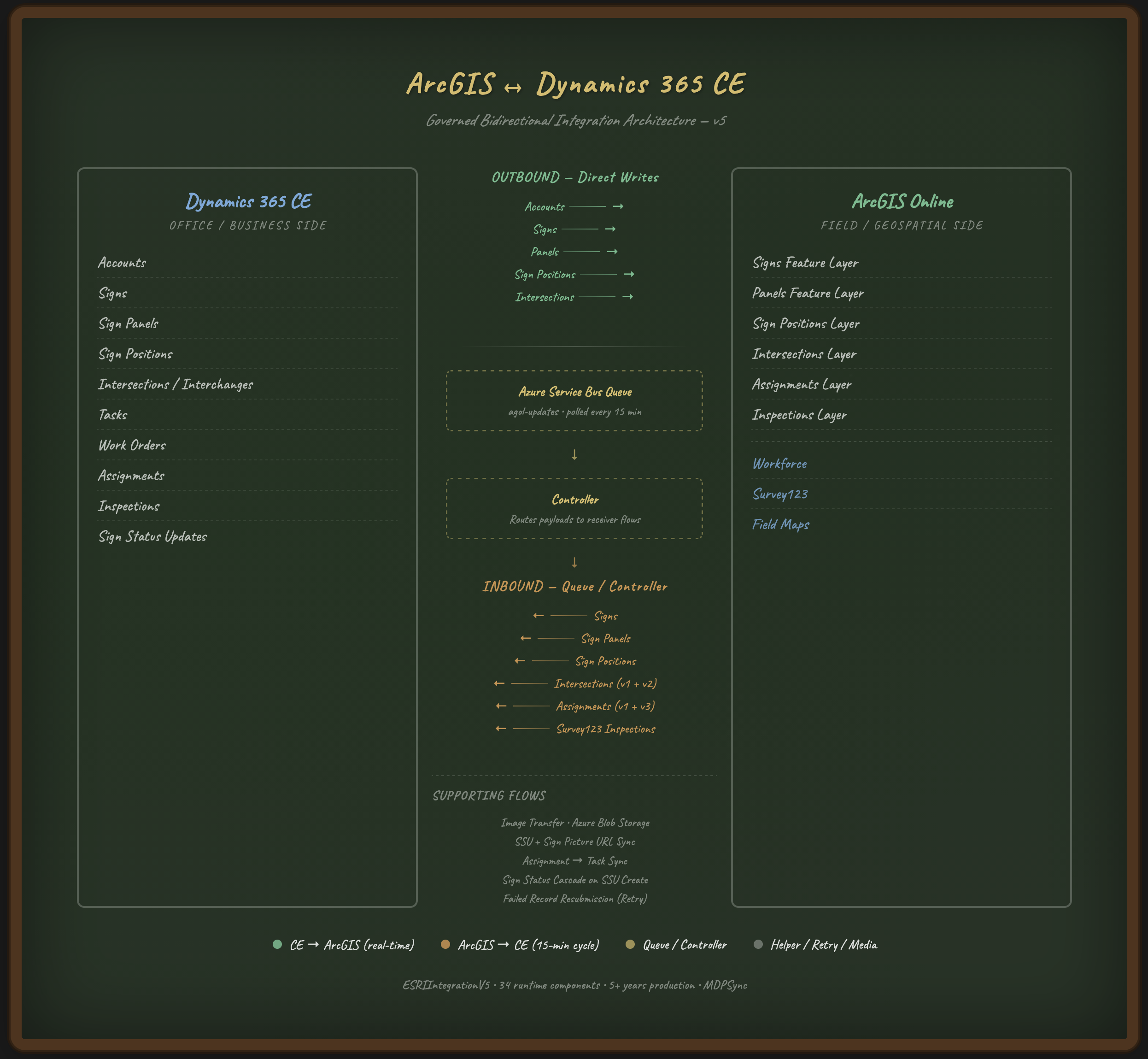
Systems architecture diagram · MDPSync · Click to enlarge
Outbound changes from Dynamics 365 are written straight to ArcGIS feature layers the moment they change. Inbound updates from ArcGIS are staged through a queue and processed by a controller every fifteen minutes, with automatic retry and error recovery. That controlled intake is protection, not a limitation. Your office system stays the authority, nothing from the field lands out of order or unmediated, and a change that cannot be processed waits on the queue instead of disappearing. The split was designed after an earlier approach proved unreliable under real operating conditions.
What Flows Between Platforms
Work Orders & Tasks
Field Assignments
Asset Inspections
Location & Geospatial Data
Status Updates & Cascading
Images & Evidence
One Closed Loop, Not Six Feeds
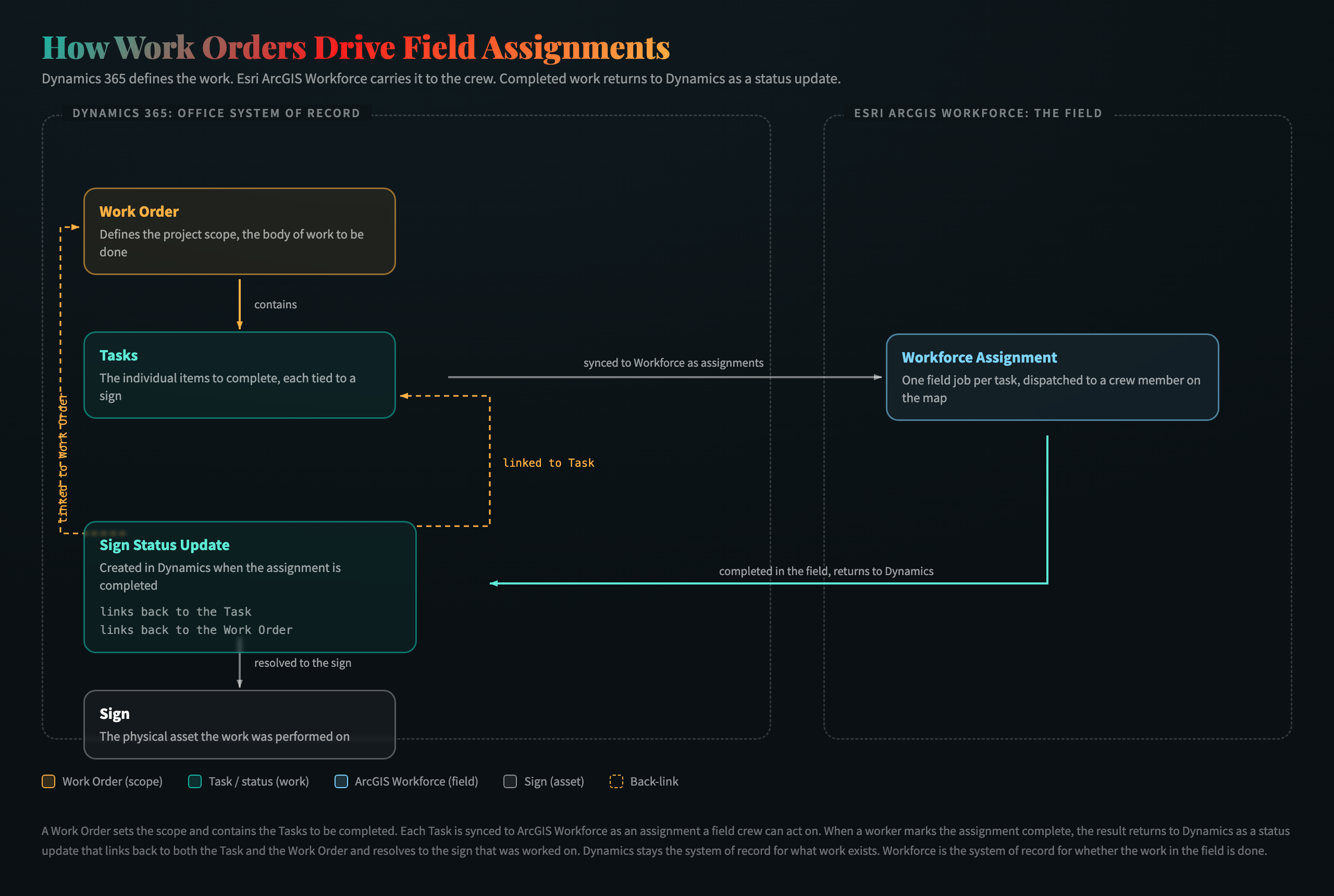
Work Order → Task → Workforce Assignment → Status Update · MDPSync · Click to enlarge
These are not six separate feeds. A work order defines the scope of a job. Its tasks are the individual items to do, and each one becomes a Workforce assignment your crew acts on in the field. When a worker closes that assignment, it flows back to Dynamics as a status update linked to the task, the work order, and the sign it was performed on. Your office defines the work, your field executes it, and the result returns with its full lineage intact. Every connection is mapped on purpose: 228 fields and 86 record relationships across eight record types, mapped one at a time, not bulk-mirrored.
The Hard Problems Nobody Warns You About
Timing and sequencing failures are invisible until they corrupt your data. An earlier outbound design queued records for ArcGIS processing, but real-world latency meant transactions were recorded before they were available. We replaced the queue-based outbound model with direct writes and built the inbound path around a controlled queue/controller pattern that respects processing order.
This is not a field-to-field copy. Every record that crosses the boundary requires option-set translation, relationship binding, parent-child sequencing, and identifier propagation back to the source system. A new value added to a dropdown in one system will break the integration if the mapping logic is not updated. We built the translation layer that handles all of it.
The previous state had no retry and no error log. Failed transmissions were simply lost, and the two systems drifted apart with no way to know what was missing. We built the recovery in. Failed records are re-attempted automatically every two hours until they are accepted, and a persistent failure posts a real-time alert to named staff in Teams, so nothing fails silently and nothing goes missing without someone hearing about it.
Six Years in Production, Self-Healing by Design
Built for state Department of Transportation directional signing and asset management programs. The figures below come from the original deployment.
The original deployment replaced a full-time staff resource that was manually copying data between systems every day. It has operated continuously through platform updates, tenant migrations, and organizational changes without requiring a rebuild. The self-healing is not a claim. Over an eleven-day test, every record that failed to transmit was brought back into sync within hours, with no operator intervention.
We Document Everything We Build
Most integration work lives in one person's head. When that person leaves, the organization is left with a system nobody understands and everyone is afraid to touch.
We produce formal documentation and review packages for everything we build. Executive review documents, evidence ledgers with code-level audit trails, certification statements, and maintenance guides. The kind of documentation that lets your next technical resource pick up where we left off without reverse-engineering the system from scratch.
For this integration, the certification package includes a reviewed inventory of every flow family (sender, receiver, controller, helper, retry, and sync), direct code-level review of 14 individual workflow exports, an evidence ledger mapping each component to its review status, and a formal certification statement with sign-off criteria.
That level of rigor is not typical. It is the difference between a vendor who ships code and a partner who leaves behind a system your organization can own, maintain, and trust.
Executive Review Packages
Leadership-ready documentation with transmittal memos, architecture summaries, and certification status.
Evidence Ledgers & Audit Trails
Component-by-component review tracking with code-level findings, open items, and resolution status.
Maintenance & Triage Guides
Practical runbooks so your team knows where to start when something breaks, not just how it was built.
This Is the Depth Behind Everything We Build
Whether it is a vibe-coded platform shipped in days or a complex multi-system integration running for years, the same architectural discipline applies. We understand enterprise platforms, government compliance, field operations, and the messy reality of keeping production systems running. That experience is what makes the speed possible.
Running Dynamics 365 and ArcGIS?
We should talk. You have just seen what this looks like running in production for more than six years. Tell us what your teams need connected, and we will tell you what it takes.